Menu

A case study on augmentation of water conservation and rejuvenation of sources through bamboo plantation by Kamal Kanti Banik : -

Problem Statement

Despite the state of Tripura is endowed with appreciable rainfall, during the last three decades it is witnessed that the perennial sources of water in the river and its branch, water falls are either dried up. Its showing result declined yield due to the impact of on-going various anthropogenic interventions like deforestation, urbanisation and traditional Jhum cultivation, cultivation of cash crops. Which are destabilised the water based economy in both the rural and urban areas. Primarily its major suffers are the land based earning community and drinking water users community.

For the better understanding and to address the above stated issues, PRA study was carried out by Dishari, an NGO of Tripura, in the tribal helmets of Ganganagar ADC Village namely the ‘Rubia Para ‘ and ‘Debbarma Para’ located on the upstream area on Khwoai River in Dhalai district of Tripura. The study was undertaking in a participatory mode involving the local community and the panchayet representatives.

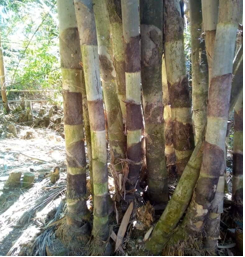
bamboo_tree_1

Although the state of Tripura is located in the highly rainfall zone of northeast India, still extreme water scarcity is felt in many pockets during the dry season (winter season). This could mainly be attributed to the practice of shifting cultivation where the forest areas are burnt to clear the areas for cultivation of paddy and other vegetables. Studies have revealed that during burning (Fig-1 &2) of the forest, the soils are also charred and it gives rise to a hydrophobic property of the soil, micro organisam and it decreases the infiltration capacity of the soil. Thus, the ground water recharge in the jhum cultivation area is significantly hindered which ultimately reduces the soil moisture and the stream flow in the area. Therefore, even though the area experiences high rainfall during rainy season, the ground water recharge remains minimal. The land remained covered with small herbs as shrubs and big trees are often being cut and burnt during the forest fire for shifting cultivation.
Fig-1&2 Forests are being burnt to create room for jhum cultivation by the tribal farmers in Ganganagar ADC Village, Dhalai district Tripura. After exhaustiveburning, the fired wood also chars the soil to turn it to a hydrophobic soil.
Our Interventions:

In view of rapid dying of water resources because of degradation of forestry through Jhum cultivation, Dishari, an NGO of Tripura, based at Belonia adopted an initiative to rejuvenate the dying sources through Bamboo plantation in the 20 hectares of degraded Jhum land on 2012.
Besides, it was envisaged that apart from the proliferation of biodiversity and improvement of hydro-ecology, the beneficiaries i.e. the owner of the degraded land can earn from the bamboo plantation after it is fully grown. For this, Dishari first organised awareness camps among the local community to apprise them on the issues.
The field workers of Dishari were trained about the activities. The work was undertaken in 2012 and the project was undertaken with the financial support of IGDC Project. Upstream areas of Khowai River in Dhalai district of Tripura.